Waterloo Is Biting the Hand That Built Its Name
The university's global reputation was forged by students and alumni in co-op, startups, and tech. When policy and culture turn against that same pipeline, the brand eats itself.

- I wrote this article 100% by hand. Yes, I use - dashes sometimes in my actual writing style *
If you're a university administrator reading this, it's worth recognizing just how much you've enabled. Building and operating an institution at Waterloo's scale isn't trivial at all. This requires coordinating massive systems, fixing infinite problems, and making sure everything from coop infrastructure to academic operations actually functions. That foundation is what allows everything else to exist. What makes Waterloo exceptional though, is how that foundation amplifies people. A university is great because of the strength of their faculty and the successes of their alumni. This is what separates a no-name university from a great one. At the end of the day, universities are simply concentrations of incredible talent into one geographic location, all working on independent studies that move the world forward (postgrad and academia) or a form of vocational training (undergrads). That is the function of a university, and on the vocational side, it's one Waterloo has been fulfilling incredibly well.
In less than 70 years, the University of Waterloo has gone from a no-name university in the middle of an unknown tiny farming town in Ontario, Canada to a global juggernaut that is mentioned among the likes of MIT, Harvard, and Stanford within silicon valley circles. Although humorously, some people have referred to mit as the “waterloo of the south”. Anecdotally, top founders have told me they prefer Waterloo students over even MIT students.
Although we have a recent nobel laureate in our faculty, academia and research isn't what makes Waterloo globally recognized. Plenty of universities in canada have more nobelists than we do (Mcgill, UofT, etc) and more than plenty of universities in the states do as well. So how is this globally unknown university even brought up in a conversation where MIT and Stanford are mentioned as well?
Answer: It's the undergraduate class and the cooperative education that sets it apart as the world's best talent vortex for silicon valley. It's the vocational training.
Waterloo takes the smartest high school kids in a country with 40+ million people (and globally) and throws them into a fiery pit of an extremely demanding curriculum. Then, it asks them to go into the hyper-competitive global economy and find a job every 4 months as someone with 0 previous job experience. And then it backs off and wishes them good luck.
If you're a dune fan, by year 4 waterloo students are essentially the emperor's elite soldiers for tech talent - the sardaukar. In the Dune series, Sardaukar are raised on the prison planet Salusa Secundus, where only the strongest survive hard conditions and constant competition. Waterloo does the same thing, except the battlefield is internships, interviews, and relentless academic pressure. By the time Waterloo kids graduate, what comes out is less student and more hardened engineering operators who have already survived the equivalent of multiple real-world campaigns.
In today's hyper competitive economy that demands utmost resilience to pain, and breakneck execution speed; the University of Waterloo serves as the padishah emperor, lending his hardened sarduakar wherever they are needed. That's why the internet has decreed Waterloo interns to be the most valuable resource, a lifeblood to silicon valley and the global economy writ large.

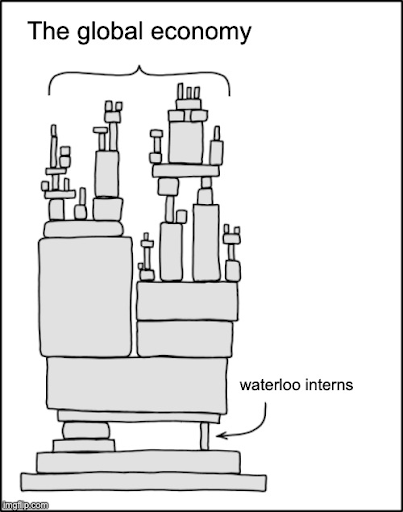
Jokes aside, there is a big problem with the University's administration. And I think these problems have the potential to kill what makes Waterloo great.
First, let's talk about what Waterloo has been doing right. Anecdotally, it seems Waterloo has been preferring to select a certain % of their cohort (call it 20-30%) by weighing their academics less and their high school non-academic accomplishments more. Would you rather a student who built an AI tool that's at 2K users over an academics oriented person who only knows how to get As in their classes? I have to give serious credit to Bill Bishop, Andrew Morton, and many other admissions staff. They are doing an incredible job.
Another thing Waterloo is doing incredibly right is academic intensity. Unlike other universities all over North America, who are famously suffering from grade inflation which makes their degrees worthless - Waterloo is actually retaining academic intensity. Waterloo actually FAILS students. Students get KICKED OUT of the university if they get below a 50 on any term, and they have to repeat a term if they get below a 60. No do-overs. No begging administrators (outside of extenuating circumstances, for which you have to go through a vogon-like bureaucratic ritual to even be considered). The test taking rules, administrative oversight, and more ensures the quality of Waterloo graduates. The same cannot be said for stanford, mit, harvard, and other “top names” (40% of Stanford students currently claim disability in order to get extra time on tests)
What Waterloo is doing wrong revolves primarily around coop, and the student experience in coop. I believe the rules and procedures for the coop program were set in a different time period and a completely different corpo-cultural atmosphere, and they either directly or indirectly hurt students and employers.
The days of working at one company for your entire life are over. The days of a possibility of a pension working a corporate job are over. The globalization of the economy and new hyper-competitiveness mean the likelihood of you being at one place forever is extremely low. One mindset Waterloo needs to get out of is coop scarcity.
Rather than the current rank-match system, which forces students to compete each other in a game-theoretical race to the bottom, it should be a student first system. Students put their resumes out, students get picked by employers, and students pick which offer they want. That way, top students get matched with top employers, just how they would in the real economy. The rank-match system is the result of a bureaucratic over-extension with trying to solve for allocation. By forcing both employers and students into a game theoretical race to the bottom, you incentivize students to game rankings and hedge outcomes, rather than just simply applying to work where they want to. Rather than try and build an artificial system for allocation (in this case the allocation problem is allocation of students to companies), rely on the best known allocation system so far; the free market. Let companies pick which students they want, let students pick which employers they want, and to the victor go the spoils. With choice allocation, top students go to top companies, and if non-top students want to work at top companies, they are incentivized to improve their resumes rather than sit on Waterloo works and play politics.
The “cycle” system, of staggered job postings, also causes undue stress and unnecessary logistical complications. This is a pre covid relic, when in person interviews were common and having the entire student population descend onto campus for interviews at one time was not feasible. However, with most interviews (82-93%) taking place online now post-pandemic, this system is not necessary anymore. This system hurts both students and employers (employers aren't able to access best talent in later cycles, and highly talented students feel locked up by worse jobs they agreed to in earlier cycles when better opportunities present themselves later).
This leads me to my biggest gripe with the current system: reneges, and the policy around reneging on private industry jobs. I'll spare you the garrulousness about the perceived “fairness” between private employer and student freedoms - what matters here isn't what's “fair”, what matters here is how this affects students. In this economic climate and this culture, you cannot expect students to behave fairly and honor employer preferences when employers almost never do the same for students. It's a very simple incentive problem. In the past, private employers would honor commitments made to employees, firings and layoffs were rare and taken seriously, and job-matching was more of a traditional bureaucratic “admissions” process. You apply, get what you get, and both parties become solidified in their engagement. Modernity presents the complete opposite. Employers rashly layoff thousands of employees one month, only to rehire them the next. Students are left stranded days before the start of their co-op term by an employer rescinding an offer. “Ghost jobs” give the impression of open roles in a company even when none exist. Expecting honorable behavior from employees and students in this climate isn't just idealistic; it's actually malicious. The labor markets in the public and private sector have diverged: and the current waterloo renege rules are a reflection of public sector employees unable to understand the reality for private sector employees.
Another problem is that previously, training employees in the private sector made economic sense, because employees tend to work at one company for a long time, so by training them you make them more productive. But in the current climate, employees come and go so fast training them becomes unprofitable. The big cultural change is that internships and coops aren't being treated as “training” by employers anymore. Interns are seen as “cheaper” junior engineers, who are still expected to perform at the full capacity a junior engineer would. With the proliferation of AI tooling, this is becoming even more apparent, as an intern in many cases now can compete with a full time junior engineer a few years their senior. Many big companies are not just resuming internship programs, but expanding them, while laying off junior engineers.
I think the best thing Waterloo can do is reduce the punishments for reneging on offers. Preventing reneges on Waterlooworks makes sense: it's Waterloo's own platform, and the platform is built by maintaining good relationships with employers; which would be hurt by constant student reneges. However, students who have arranged their own external job being punished for reneges is absolutely ludicrous. The problem is this isn't even a measurable issue, since the number of students who just take the worse offer because they don't want to renege is so high, and you can't measure the number of people who don't make a decision. Anecdotally though, almost every Waterloo student takes a worse offer at least once. And all of them hate it. I think the best course of action for the renege rules is giving students a one term ban on Waterlooworks if they renege on a job gained through the platform, and no consequences if they renege on a job arranged outside the university's resources.
Lastly, there is work to be done around student support. Waterloo students are Canada's best and brightest, but learning how to “put themselves out there” is entirely a personal effort. Students must learn from first principles the best way to advertise themselves, advertise their skills, and both land jobs and other opportunities in this competitive environment. However, the university provides little support in this regard. One extremely positive support the university does provide is free Pitchbook access to students. Typically costing thousands of dollars per month, a pitchbook terminal allows you to see the funding statistics and executive teams for most major startups in North America. This is an absolutely incredible resource, and has helped countless students in starting their own company or figuring out a good company to work for. We need more software offered to the student population for free. For one, having a free linkedin premium subscription for all Waterloo students would be a tremendous value add. This would give Waterloo students an even bigger competitive advantage over other schools, and would allow students to find their way around industry much faster. Dozens of other helpful softwares can be given to students, that provide meaningful network and professional value.
The University of Waterloo is, without exaggeration, one of the most remarkable talent-producing institutions in the world. In under 70 years, it built something that most universities with centuries of history haven't - a reputation that precedes itself in the most competitive rooms on earth. That only happens because the institution made hard, correct decisions about academic rigor, admissions philosophy, and cooperative education. But institutions who don't evolve freeze themselves in time. The coop infrastructure that made Waterloo legendary was designed for a world that no longer exists: a world of in-person interviews, loyal employers, and predictable labor markets. That world is gone. The students walking through Waterloo today are operating in a brutally competitive, fast-moving, often unfair economy - and the administrative scaffolding around them should reflect that reality. Fix the rank-match system. Kill the cycle model. Reform the renege policy. Give students the tools to compete. Waterloo students are going out into the economic battlefield and winning - let's make sure we give them body armor that fits.